
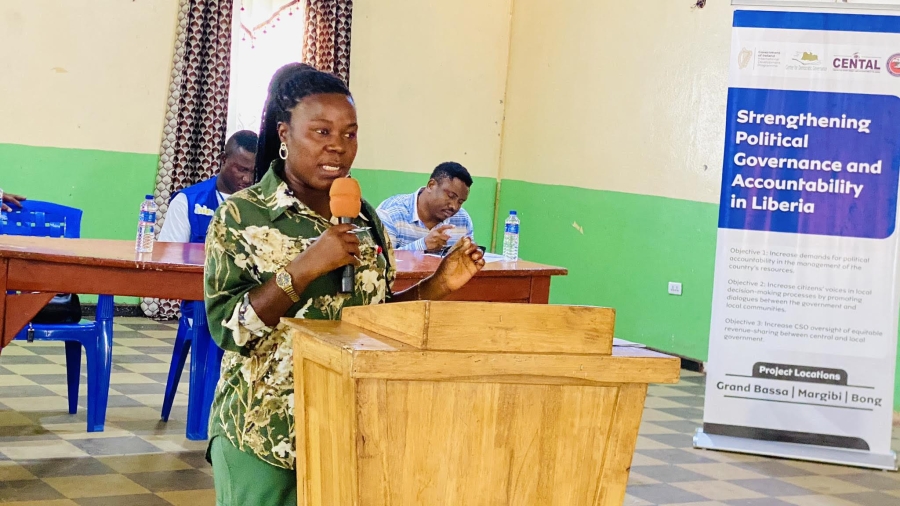
International Anti-Corruption Day – December 9
Distinguished guests, fellow young people, ladies and gentlemen:
Today, we join the world to reflect on a challenge that threatens our development, dignity, and democracy. This year’s global theme calls on us to unite with young people to build a future rooted in integrity, and our national sub-theme reminds us that this fight must reach beyond Monrovia into every village, community, and county.
Global Theme: ‘Uniting with Youth against Corruption: Shaping tomorrow’s Integrity’
Sub-Theme: ‘Decentralizing the Fight against Corruption; Mobilizing Rural Youth to Demand Accountability and Better Service Delivery’
before we point fingers upward, we must face an uncomfortable truth: the foundation of corruption is the mindset of the people.
Transparency International defines corruption as the “abuse of entrusted power for private gain.” Yet corruption does not begin in high offices. It begins with small wrongs we justify, shortcuts we celebrate, and a culture that elevates corrupt individuals simply because we expect favors in return. We “name and shame,” but often, we praise, elect, and empower the very people we accuse.
This is why accountability is not only a government problem, it starts with us.
EXAMINING THE SYSTEM
Before we demand accountability, we must ask:
- Are systems in place?
- How effective are they?
- Who monitors them?
- And when they fail, who do we run to?
But equally important is another question we must ask ourselves: Are our own hands free from the cookie jar?
We criticize public officials, yet corruption lives in our homes, schools, communities, and institutions.
- Some civil society organizations issue blank receipts.
- Some journalists collect “carto.”
- Some religious leaders sell anointing oil for prosperity.
- Some community leaders receive money meant for the people but never report it.
If we must demand accountability from the top, then we must practice accountability at the bottom. We cannot clean the nation without first cleaning our corners.
CORRUPTION AND SERVICE DELIVERY
Corruption affects education, health care, agriculture, justice, and infrastructure. But systems themselves are not corrupt, people build systems, and mindsets sustain them.
A corrupt system exists because:
Someone approved the wrong contract.
Someone inflated a budget.
Someone diverted public funds.
And someone else stayed silent.
This is why decentralization matters. When rural youth are empowered to question, monitor, and demand accountability, corruption has nowhere to hide.
The County Service Centers (CSCs), created in 2015, were designed to bring government services closer to the people. By presidential directive, 40% of revenue generated by each CSC should remain in the county for operations.
But are we accessing these services without hindrance? Are we tracking how that 40% is used?
Too often we celebrate leaders based on what they give us personally rather than what they deliver for society. We honor titles instead of honoring the true heroes, the charcoal sellers, pepper sellers, market women, and young hustlers who keep our communities alive.
When politicians buy support with personal money, they enter office indebted to everyone except the citizens. And how do they repay? By exploiting the system meant to provide services to the people.
Corruption becomes systematic, not by accident, but by design, sustained by our silence.
WHY YOUTH?
Liberia has a youthful population, about 63% under age 25 and nearly 70% under age 35. Youth make up roughly half of registered voters. This makes young people powerful agents of change.
But are we asking the hard questions?
The 2025 national budget is US$880,661,874.
- How much of that is allocated to Margibi?
- How much goes to health, education, sanitation, roads, and youth development?
- How are county sitting representatives selected?
- Why are schools charging extra graduation fees not approved by the Ministry of Education?
These questions are not for lawmakers alone; they are for every young person.
If we do not ask, rooms remain silent.
If we do not ask, budgets pass unnoticed.
If we do not ask, corruption continues unchecked.
If young people in Monrovia can demand accountability for justice, health care, and governance, then young people in rural counties must do the same. That is why local government structures exist to bring oversight closer to the people.
CONCLUSION
The fight against corruption will not be won by laws alone, institutions alone, or speeches alone. It must be won through mindset change, community involvement, and personal accountability.
Let this be the generation that refuses to celebrate corrupt individuals.
Let this be the generation that honors true heroes, the hardworking mothers, fathers, teachers, market women, and honest public servants.
Corruption is not a distant enemy; it is a daily test of conscience.
If we unite as youth, decentralize the fight, demand accountability, insist on quality service delivery, and challenge the system from the community level upward, then we will not only talk about integrity, we will shape it, build it, and live it.
Together, we can shape tomorrow’s integrity.
Thank you.
