Assessing the Risk of Corruption in Universities and High Schools
By Mark Boahndao
Of all the forms of corruption, bribery and sextortion (favors in exchange for sex) are believed to be the most prevalent in schools. To understand the risks and factors that fuels corruption in universities and high schools, a corruption risk assessment survey has been conducted by students of the very universities and schools.
These activities have been conducted as part of the Youth Engagement Activities. The Corruption Risk Assessment was commissioned amongst others, to ascertain issues and concerns students are faced with on their various campuses. This process was aimed at gathering information and data on the state and level of corruption in the education sector.
Moreover, it helped to identify key problems that tend to hinder students’ learning, access to quality education as well as faculty-to-student relationship and student-to-student relationship.
The key objectives of this exercise was to identify issues and challenges students are faced with on their various campuses (schools and universities) and to use the findings to tackle issues identified from the survey and tailor it into our program’s activities for robust interventions.
The survey employed non-probability sampling which is generally considered as convenience sampling approach of obtaining data by using non-random means based on availability, geographical proximity or expert knowledge of individuals in a study.
Participants were largely selected based on accessibility, and were allowed to get involved with practical and feasible data collection processes. This survey approach involved Key Informant Interviews (KII), Focus Group Discussions (FDG) aimed at gauging the perspectives and insights of selected respondents from high schools and universities. The total of twenty-five (25) enumerators were carefully chosen from four universities and high schools. Each enumerator was tasked with conducting interviews with 25 participants.
Consequently, these students gathered at their various campuses to initiate this process and came up with interesting findings. The total number of participants interviewed were three hundred thirty-two (332) constituting 38.8 % male and 41.8% female. They predominantly comprised of students and administrators, including those from high schools and universities.
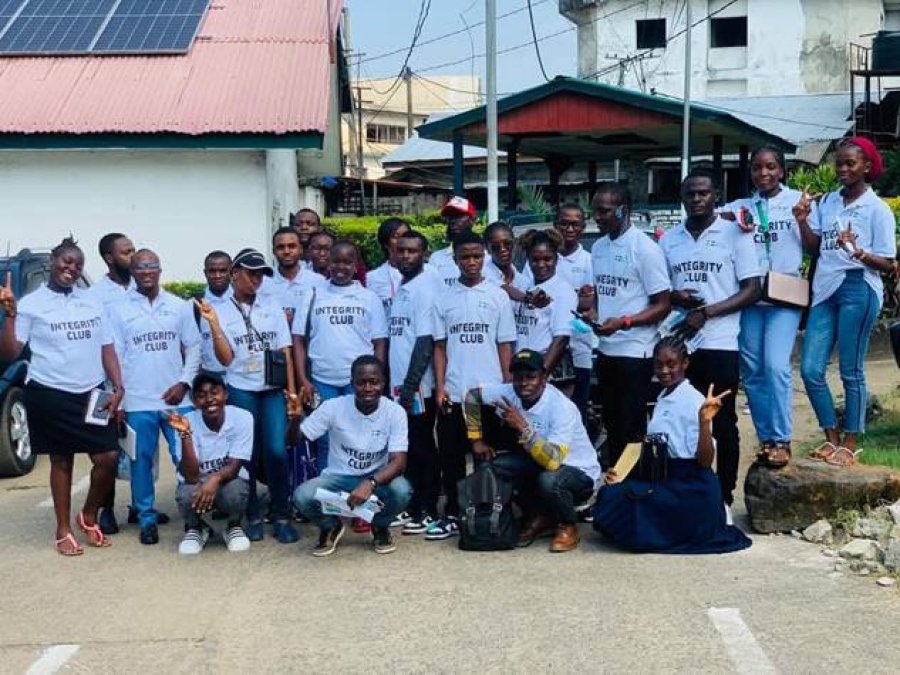
Nearly after a month of the assessment exercise, students from different universities and a high school represent by the Ford Madden Christian Academy assembled to validate the document at the United Methodist University Campus on Ashmun Street in Monrovia.
Though tense, however, the validation process had many recommendations. For instance, the overall results from the survey conducted on how accessible is the school facilities to Persons with Disability (PWD) indicated that 31% noted that it was inaccessible while 21% said it was accessible. 18% said very accessible while 20% said, they do not know. This signifies that there is need to make school facilities disable friendly and accessible to all persons including disadvantaged people.
Few among the recommendations emanating from the validation calls for strengthening relationships among students, teachers and administrators. For the most part, there should be a cordial learning environment wherein student leaders, teachers and administrators can freely discuss issues, share ideas, information and collaborate. This could help improve trust and enhance two ways communication within the institution.
More importantly, information on all institutional and academic policies, including code of conduct, student’s handbook and other procedures to keep students informed and abrupt. Additionally, copies of these documents should be shared with if not all students, especially during registration, admission, and orientation processes to help students understand and adhere to academic policies more appropriately.
Since 2004, the Center for Transparency and Accountability in Liberia (CENTAL) has been combatting corruption, promoting anti-corruption and transparency efforts as well as good governance principles and integrity building through various programs across Liberia. With the involvement of youth in preaching integrity and anti-corruption messages in universities and high schools through the establishment of integrity clubs, the narratives of youth inclusion in the fight against corruption is being manifested regardless of age, ethnicity, color or religion.
The IClub, also referred to as Youth Engagement Program was established at the state-run University of Liberia in 2018. Serving as a frontier force to reach young people in universities, high school, and communities, it was later expanded to three private universities in 2020 through the Swedish International Development Cooperation (SIDA)’s support. With the aim of training and empowering students to become ambassadors of integrity and agents of change in the respective areas of learning and society, the Integrity Club has stretched its tentacles to seven (7) counties: Nimba, Bong, Rivercess, Grand Bassa, Gbarpolu, and Bomi with Montserrado at the zenith of the activities.
The success for IClub can be primarily alluded to university and school’s administrators and students for playing active roles in improving the quality of educational services and ensuring a corruption-free learning environment.
Considering the trend of corruption and the risk involved in universities and high schools, the strides for ensuring a corruption-free learning environment continues as different activities are being innovatively thought-out.